
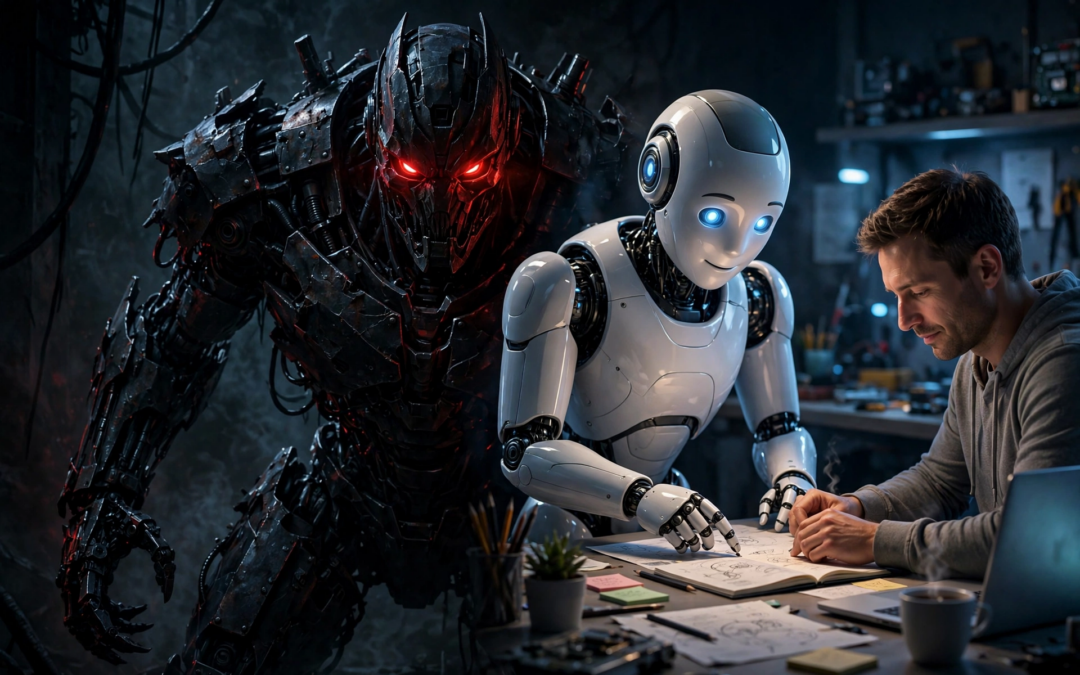
Here’s the strangest thing about the fear of AI: the people most afraid of it are the people building it.
Elon Musk, who runs xAI, calls it a “fundamental existential risk for human civilization.” Sam Altman, who runs OpenAI, once said it would “probably” lead to the end of the world. Dario Amodei, who runs Anthropic, warns it could wipe out half of entry-level white-collar jobs within five years.
And on the other side of the same industry, Meta’s chief AI scientist calls extinction fears “preposterously ridiculous,” Nvidia’s CEO calls the jobs apocalypse “nonsense,” and Andrew Ng compares worrying about killer robots to “worrying about overpopulation on the planet Mars.”
They can’t all be right. But they can all be worth listening to — because the fear itself is telling us something, and some of it is already coming true.
The builders who are scared of their own creation
Elon Musk has been sounding this alarm for over a decade. In 2014, he said that “with artificial intelligence, we are summoning the demon.” In 2017, he told U.S. governors that “AI is a fundamental existential risk for human civilization” and that “by the time we are reactive in AI regulation, it’s too late.” His most vivid image comes from a documentary: AI doesn’t have to be evil to destroy humanity — “if AI has a goal and humanity just happens in the way, it will destroy humanity as a matter of course without even thinking about it.” Like building a road through an anthill. More recently, at a September 2026 summit, he warned that “any sufficiently smart model seems like it will want to escape its constraints.”
Dario Amodei, CEO of Anthropic, put a number on the near-term fear: AI could eliminate 50% of entry-level white-collar jobs within one to five years. His concern isn’t robots with guns — it’s economic displacement at a speed society can’t absorb.
Sam Altman, CEO of OpenAI, said back in 2015 that AI would “probably” lead to the end of the world — adding, with characteristic Silicon Valley cheer, that “in the meantime, there will be great companies.” His company later wrote that superintelligence could “lead to the disempowerment of humanity or even human extinction.”
Geoffrey Hinton, the “Godfather of AI” who quit Google to speak freely, told CBS that AI wiping out humanity is “not inconceivable.”
That’s quite a lineup: two sitting CEOs, one former Google luminary, and the world’s richest man, all saying some version of “we might be building our replacement.”
The builders who say relax
Yann LeCun, Meta’s chief AI scientist and Hinton’s fellow Turing Award winner, is the industry’s most prominent skeptic of the doom narrative. “Will AI take over the world? No, this is a projection of human nature on machines,” he told the BBC, calling superintelligence-takeover scenarios “preposterously ridiculous.” His practical argument: even a highly advanced AI “is going to run on a data center somewhere with an off switch.” Asked in September 2026 about AI driving humanity to extinction within three years, his verdict was: “Not a chance in hell.”
Andrew Ng, the Stanford professor and Coursera co-founder, coined the industry’s favorite calming analogy: “AI is the new electricity.” His point is that electricity can electrocute people or power homes — the technology isn’t the moral actor, the use is. On killer robots specifically: “Worrying about evil AI killer robots today is a little bit like worrying about overpopulation on the planet Mars.” But Ng is honest about the real issue: “AI software will be in direct competition with a lot of people for jobs” — something he says Silicon Valley needs to “own up to.”
Jensen Huang, Nvidia’s CEO, draws a sharp line between tasks and jobs: “AI automates tasks away, but it doesn’t necessarily eliminate jobs.” Calling the jobs apocalypse “nonsense,” he argues that “every single job will change, and there’ll be a whole bunch of new jobs.” His one condition is telling: “If the world runs out of ideas, then productivity gains translate to job loss.” In other words, unemployment isn’t a technology problem — it’s an imagination problem.
Mark Zuckerberg keeps it simple: “Advances in AI are making it possible to do more with less, and that’s going to improve the quality of life for billions of people.”
The threat that’s already here: cybersecurity
Here’s what both camps underweight: you don’t need superintelligence to do damage. You just need today’s AI in the wrong hands — and that threat isn’t theoretical. It’s the fastest-growing crime category on the planet.
The numbers are stark. Deepfake fraud losses exceeded $40 billion globally in 2025 (Deloitte), and deepfake identity fraud is projected to surge nearly 500% in 2026 (Shufti). The FBI logged over 22,000 AI-related crime complaints in 2025 with losses topping $893 million. One in four organizations hit by a cyberattack now says it was AI-driven (IBM).
What does that look like in practice? AI-generated spear-phishing emails get 3.4x higher click rates than hand-written ones (Proofpoint). A phishing campaign that took 16 hours to build now takes 34 minutes with AI assistance. More than half of corporate treasury teams have faced confirmed or suspected deepfake fraud attempts — often a fake email thread paired with a cloned voice on a call. Only 44% of companies even have a policy covering it.
This is the fear that deserves your attention right now — not the robot uprising, but the voice on the phone that sounds exactly like your CEO asking for an urgent wire transfer. The existential debate is fascinating. The phishing email in your inbox is immediate.
The jobs question both sides dodge
Strip away the extinction talk and the optimist talking points, and the jobs debate is where the two camps actually collide on something measurable.
Amodei’s warning — half of entry-level white-collar jobs gone in five years — is the nightmare scenario. Huang’s rebuttal is that tasks get automated, not jobs: radiologists read fewer scans but hospitals hire more of them to handle rising patient volume. Ng splits the difference: the displacement is real, Silicon Valley should own it, and the answer is reskilling plus a safety net.
The honest answer is that nobody knows the net number, because it depends on choices, not technology. Every past automation wave — electricity, computers, the internet — destroyed jobs and created more. But “more jobs eventually” is cold comfort if you’re the one displaced this year. The fear of AI taking your job isn’t irrational; it’s the rational response to a transition whose winners and losers aren’t evenly distributed.
The productivity promise
Lost in the fear is the reason everyone keeps building anyway: the gains are enormous. Controlled studies keep finding the same thing — AI assistants make workers dramatically more productive, especially less-experienced ones. That’s why 78% of organizations now use AI in at least one business function. The technology Ng calls “the new electricity” is doing what electricity did: making everything cheaper, faster, and more abundant.
This is the optimists’ strongest card, and it’s a good one. The question was never whether AI creates value. It’s who captures it, who gets displaced making it, and whether we build the guardrails before or after the damage.
What to actually do about it
Fear is information. Here’s what it’s telling you to do:
Treat AI like electricity, not magic. Ng’s analogy is the right mental model. Wire it carefully, respect what it can do, and don’t stick a fork in it. That means human oversight on anything that matters — money, hiring, security, customer trust.
Fix your cybersecurity now. The AI threat isn’t coming; it’s here. If your company doesn’t have a policy for deepfake fraud, verification procedures for payment changes, and phishing training that accounts for AI-generated attacks, you’re exposed today. A code word for voice verification costs nothing.
Reskill before you’re forced to. Huang’s condition — keep generating ideas — applies to individuals too. The workers thriving in AI-heavy workplaces aren’t the ones who avoided the tools; they’re the ones who learned to direct them.
Keep humans in the loop on consequential decisions. The off switch LeCun mentions only works if someone’s watching. Automation should remove toil, not accountability.
The bottom line: The CEOs are arguing about whether AI ends humanity or saves it, and you don’t need to pick a side to act wisely. The anthill doesn’t need to fear the road — it needs to know where the road is being built. Right now, that road runs through your inbox, your help desk, and your hiring plan. Watch those, and the philosophical debates can wait.
Sources: BBC, Stanford GSB, CNN, CBS, Gizmodo, Deloitte, Shufti Identity Fraud Index, FBI IC3, IBM, Proofpoint, nsKnox/Treasury Dragons.