
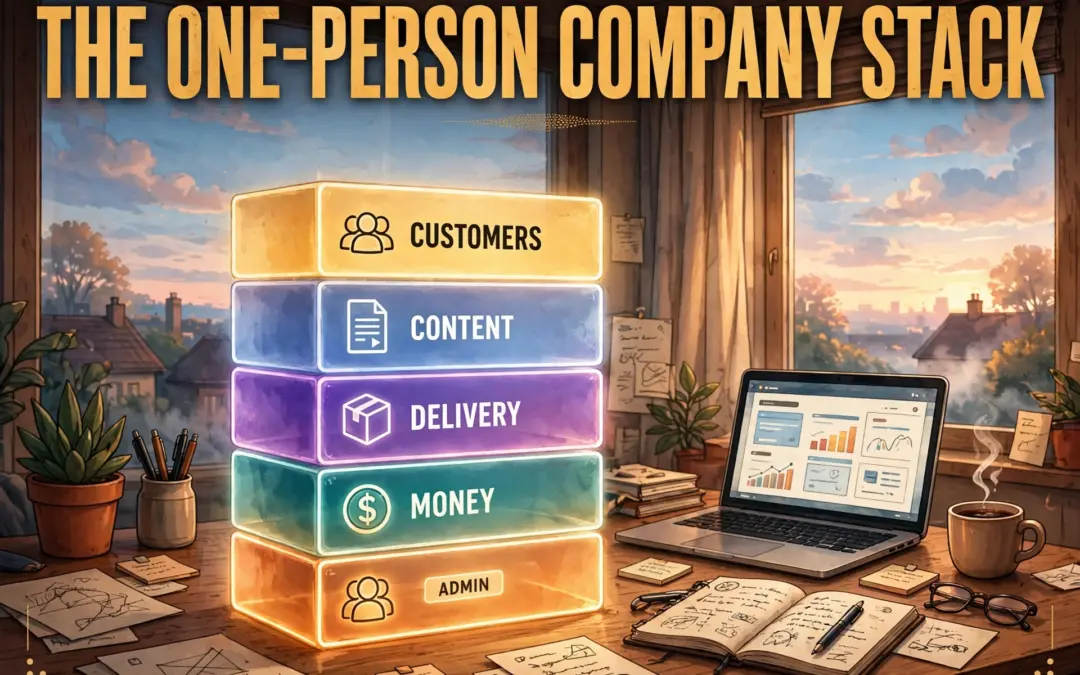
The One-Person Company Stack: What a Solo Operator Actually Needs in 2027
A one-person company does not fail because it picked the wrong app. It fails because it bought twelve apps before it had one customer, then spent its mornings maintaining the machine instead of running the business.
The good news: in 2027, a solo operator genuinely can do the work that used to take a small team. The bad news: the tool market knows it, and it will happily sell you a “stack” that costs more per month than your first product earns. So let’s build the honest version — five layers, one job each, and a clear list of what to skip.
A stack is not a shopping list. It is five jobs that have to get done every week, whether you do them or software does.
Layer 1: Customers — how people find you and raise a hand
Everything starts here, because nothing else matters until someone can find you and say “I’m interested.”
You need exactly three things:
- One home base — a simple website or landing page you control, with one clear offer and one clear next step.
- One channel you actually enjoy — a newsletter, a social account, a podcast, short video. Pick the one you will still be doing in month six. Consistency beats coverage.
- One way to capture interest — an email signup or a booking link. Calendly handles the “let’s talk” moment without the email tennis match.
Skip: being on five platforms at once, a CRM with pipeline stages for a pipeline of three people, and any “growth” tool that promises followers. At solo scale, your customer layer is a notebook with good habits until the volume proves otherwise.
Layer 2: Content — the engine that feeds Layer 1
Content is how a one-person company punches above its weight. The trick is that content is a workflow, not a series of heroic efforts.
A workable solo content layer looks like this:
- One AI drafting partner. ChatGPT or Claude — pick one and learn it deeply instead of dabbling in four. Use it for outlines, first drafts, repurposing, and editing. You remain the editor-in-chief; the model is the fastest junior writer you will ever hire.
- One capture habit. Ideas go into a single note the moment they appear. A tool like Notion works well as the idea inbox, draft shelf, and publishing calendar in one place.
- One repurposing loop. One substantial piece per week, broken into smaller pieces for your channel. (We have written before about turning one livestream into seven assets — the same logic applies to any anchor piece.)
Skip: AI avatar video suites, multi-platform schedulers with analytics dashboards you will never open, and generating thirty posts a day. Volume without a point of view is just noise with a posting schedule.
Layer 3: Delivery — how the work actually gets to the customer
Delivery is the layer solo operators most often overbuild, because it feels like “the real business.” Keep it boring:
- Digital products and simple services deliver themselves. Gumroad can host the file, take the payment, and email the customer while you sleep.
- Client work needs a shared folder, a simple project board, and templates for the things you do repeatedly — proposals, onboarding, reports. Templates are the cheapest employee you will ever have.
- Your knowledge is part of delivery too. Every time you answer the same question twice, write the answer down where future-you (and your AI tools) can find it.
Skip: custom client portals, elaborate project-management suites, and automating a process you have only run twice. Automate the tenth repetition, not the second.
Layer 4: Money — getting paid without a finance department
This layer has one rule: the path from “yes” to “paid” should be as short as physics allows.
- One payment processor. Stripe for services and invoicing, or a store platform that handles payments for you. One is enough until a customer forces a second.
- One invoice habit. Same day, every time, with a payment link in the message. Most “late payments” at solo scale are really late invoices.
- One weekly money check. Fifteen minutes, same time each week: what came in, what is owed, what renews soon. That last item matters more than it used to — if you have never audited what your tools quietly renew for, run the subscription audit before you add anything new.
Skip: multi-currency accounting platforms before you have a second currency, and dashboards that visualize revenue you could count on your fingers.
Layer 5: Admin — the glue that keeps the other four connected
Admin is where AI quietly earns its keep in 2027. Not with grand autonomous agents, but with small, reliable connections:
- Glue automations. Zapier or Make move data between your layers: a new payment adds a customer to your email list; a booked call creates a prep note; a published post gets logged. Start with two or three of these, not twenty.
- An AI assistant for the paperwork. Summarizing calls, drafting follow-up emails, turning voice notes into task lists. Unglamorous, and worth hours a week.
- A password manager and backups. Unglamorous squared — and the difference between a bad day and a lost business.
Skip: building your own automations in code before the no-code version breaks, and any tool whose setup takes longer than the task it saves.
How the pieces connect
Here is the whole stack in one flow: a piece of content brings a customer to your page; the customer books or buys; delivery happens through a template or a file; money lands through one processor; admin automations file the receipt, add the customer to your list, and remind you to follow up. Five layers, each doing one job, each handing off cleanly to the next.
When something breaks, you will know exactly which layer broke — and that is the real test of a stack. If you cannot say which layer a tool belongs to, you probably do not need the tool.
The blueprint, done for you
If you want this stack as a worked plan rather than a philosophy — the layers mapped out, the offers, the client systems, the AI workflows — that is exactly what The AI Business Empire Blueprint by Digital Life Manager is: a 77-page consultant kit for building a one-person, AI-leveraged business, available on Gumroad for $17.
And this weekend is the cheap time to grab it: code BLKFRIDAY7 takes 40% off through Monday Nov 30, 2026, 11:59 PM ET.
Get it here: The AI Business Empire Blueprint — Gumroad
Build the five layers in order. Customers first, admin last, and nothing you cannot explain in one sentence. That is the whole stack — and in 2027, it is enough to run a real company of one.